
The ICJ’s Climate Verdict
What Happens to Business When States Are Legally
Bound to Regulate Private Emitters
Aliyah Assegaf
July 25, 2026
Overview
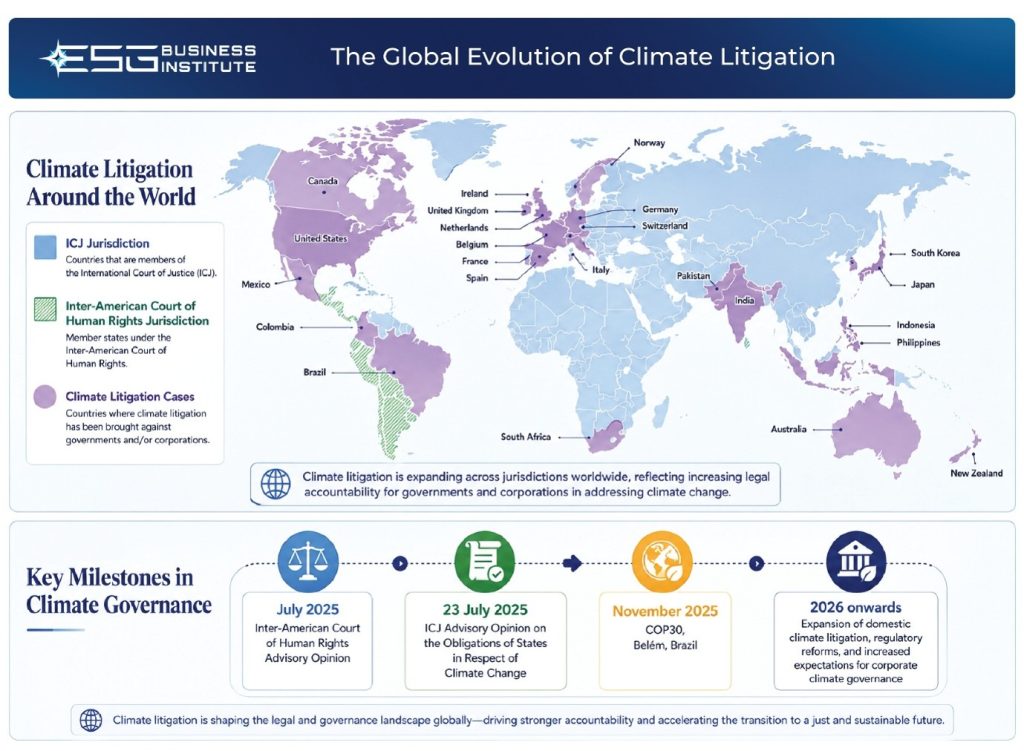
On 23 July 2025, the International Court of Justice (ICJ) issued a landmark advisory opinion confirming that States have binding obligations under international law to protect the climate system, including by regulating private greenhouse gas emissions.
Although the opinion does not create direct legal obligations for businesses, it strengthens the legal foundation for future climate regulation. As governments translate these obligations into domestic law, companies can expect greater regulatory scrutiny, stronger investor expectations, and increased pressure to demonstrate credible climate strategies.
Climate action is no longer just a sustainability or reporting issue. It is increasingly becoming a matter of legal preparedness, enterprise risk management, and long-term business resilience.
1. The Opinion: What the ICJ Actually Said
The ICJ’s Advisory Opinion on the Obligations of States in Respect of Climate Change was requested by the United Nations General Assembly following an initiative led by Vanuatu and other climate-vulnerable nations seeking legal clarity on governments’ responsibilities to address climate change.
The Court unanimously affirmed that States have binding obligations under international law to protect the climate system for present and future generations. It also confirmed that the Paris Agreement creates legally binding obligations for States, and that COP decisions play an important role in interpreting and implementing those commitments.
The Court further recognised that climate change threatens internationally protected human rights, including the rights to life, health, and an adequate standard of living, reinforcing the growing connection between climate law and human rights.
For businesses, however, the most significant finding is the Court’s confirmation that governments are expected to regulate private-sector greenhouse gas emissions to meet their international obligations. As noted by Hogan Lovells, failure to regulate significant private emissions could constitute a breach of international law.
While the opinion does not directly bind companies, it makes clear that governments will be expected to strengthen domestic laws and climate policies. Businesses are therefore likely to experience its impact through evolving regulation, higher governance expectations, and increased scrutiny of emissions management and transition planning.
2. The Inter-American Court Companion Opinion
The ICJ’s opinion was followed just weeks earlier by a landmark advisory opinion from the Inter-American Court of Human Rights (IACtHR), reinforcing the growing convergence between climate law, business responsibility, and human rights.
The IACtHR recognized that businesses play a fundamental role in addressing the climate crisis and that States have a duty to regulate corporate climate impacts. It also introduced the principle of differentiated corporate responsibility, recognizing that companies with larger emissions profiles or greater historical contributions to climate change may face more stringent regulatory expectations.
Together, the ICJ and IACtHR opinions establish a clear international direction. Governments are increasingly expected to strengthen climate regulation, while businesses are expected to demonstrate credible climate governance, emissions management, and responsible business conduct. The implications extend beyond environmental policy, creating stronger legal foundations for future action against carbon-intensive projects, high-emitting industries, and the financial institutions that support them.
As noted by Opinio Juris in The ICJ Advisory Opinion on Climate Change: A Business and Human Rights Perspective, the two advisory opinions also strengthen the relationship between climate obligations, business responsibility, and international human rights law. Together, they reinforce the expectation that businesses will increasingly operate within legal frameworks that connect environmental performance with broader human rights responsibilities
3. Why Non-Binding Does Not Mean Non-Consequential
Although the ICJ’s advisory opinion is not legally binding, it is one of the most authoritative interpretations of international climate law. Advisory opinions frequently shape legislation, judicial decisions, regulatory reform, and international negotiations.
As governments implement the Court’s interpretation through domestic laws and policies, businesses are likely to face stricter climate regulation, stronger disclosure requirements, and increasing expectations for credible transition planning. The opinion also strengthens the legal basis for climate litigation against governments that fail to regulate significant sources of greenhouse gas emissions, potentially accelerating regulatory action across multiple jurisdictions.
Legal experts also expect the opinion to influence future Nationally Determined Contributions (NDCs), investor-state disputes, and climate-related investment policies. For businesses, the practical impact will not come from the Court itself, but from the regulations, market expectations, and legal developments that follow.
The message is straightforward: while the opinion does not directly impose obligations on companies, it is likely to shape the legal and commercial environment in which businesses operate for years to come.
Beyond domestic regulation, the ICJ opinion is expected to influence international investment disputes, future Nationally Determined Contributions (NDCs), and broader climate policy. As noted by DLA Piper and Latham & Watkins, these developments are likely to accelerate regulatory change and reshape the legal, investment, and business environment in which companies operate.
4. The Business Exposure: Three Channels of Risk
The ICJ’s advisory opinion is unlikely to affect businesses through direct enforcement. Instead, its impact will be felt through stronger regulation, evolving legal interpretation, and changing investor expectations. Together, these developments create three key channels of business risk.
Channel 1 — Climate Litigation
Climate litigation is expanding beyond governments to major emitters and other organizations linked to high-emissions activities. Companies in sectors such as energy, mining, cement, steel, aviation, and shipping are increasingly facing legal challenges over their contribution to climate change.
The ICJ opinion provides domestic courts with a stronger legal foundation when interpreting governments’ climate obligations, which could indirectly influence future cases involving businesses. While companies are not directly subject to the Court’s jurisdiction, organizations with weak climate governance or inadequate transition plans may face increasing legal and reputational risks.
Channel 2 — Regulatory Acceleration
The most immediate impact for many businesses will be stronger climate regulation. By confirming that States have legal obligations to regulate greenhouse gas emissions, the ICJ opinion provides governments with greater justification for introducing more ambitious climate policies.
Businesses should expect stricter emissions standards, enhanced climate disclosures, sector-specific decarbonization requirements, and greater expectations for credible transition planning. Organizations that strengthen climate governance and emissions management early will be better prepared to adapt as regulatory requirements evolve.
Channel 3 — Financing and Investment Risk
Climate risk is increasingly influencing capital allocation. Investors, lenders, insurers, and financial institutions are placing greater emphasis on climate governance, transition planning, and emissions performance when assessing investment and financing decisions.
Businesses that cannot demonstrate credible climate strategies may face higher financing costs, increased due diligence, reduced investor confidence, and growing pressure from shareholders and customers. At the same time, organizations with robust governance and clear transition plans are likely to be better positioned to attract investment and strengthen long-term competitiveness.
Together, these three channels demonstrate that climate risk is no longer confined to sustainability reporting or regulatory compliance. It has become a strategic business issue that affects legal exposure, access to capital, operational resilience, and long-term value creation.
5. The Asia Dimension: What the Opinion Means for the Region
Although the ICJ’s opinion has global implications, its origins lie in Asia-Pacific. Pacific island nations, among the countries most vulnerable to climate change, successfully brought the issue before the world’s highest court, turning the experiences of climate-affected communities into a landmark development in international law.
For governments across Asia, the opinion strengthens the legal basis for more ambitious climate policies. As countries translate their international commitments into domestic legislation, businesses can expect tighter regulatory requirements, enhanced climate disclosures, and greater expectations for emissions reduction and transition planning.
The implications extend beyond national borders. Companies operating across global supply chains or exporting to international markets are likely to face increasing expectations from customers, investors, and regulators to demonstrate effective climate governance, emissions management, and responsible business practices, regardless of where they operate.
For businesses across Asia-Pacific, climate risk is no longer limited to physical impacts or sustainability reporting. It is becoming a strategic business issue that influences market access, financing, regulatory compliance, competitiveness, and long-term resilience.
ESG-BI Commentary
For ESG-BI members, the takeaway is clear: businesses must build resilience not only to market forces and competition, but also to the social and environmental disruptions that increasingly affect supply chains, infrastructure, operations, business costs, and consumer behavior.
The ICJ Advisory Opinion reinforces this reality. While it places legal obligations on States rather than businesses, it signals a future of stronger climate regulation, evolving market expectations, and greater scrutiny from investors, customers, and financial institutions. Organizations that anticipate these changes will be better positioned than those that respond only after regulations take effect.
It is no longer enough to treat compliance, transition risk, or physical climate risk as separate issues outside the business. That approach is too narrow. Climate and broader ESG risks shape core business performance, strategy, resilience, and long-term profitability.
The companies best positioned for the future will be those that embed climate governance into business strategy, strengthen transition planning, and monitor legal and regulatory developments early. Resilience comes from integration, not isolation. By embedding ESG into decision-making across the business, organizations will be better equipped to manage disruption, maintain stakeholder confidence, protect long-term value, and sustain business continuity in an increasingly complex operating environment.
Further Reading
- House of Commons Library. International Court of Justice Advisory Opinion on Climate Change. https://commonslibrary.parliament.uk/research-briefings/cbp-10354/
- Hogan Lovells. International Court of Justice Advisory Opinion on the Obligations of States in Respect of Climate Change. https://www.hoganlovells.com/en/publications/international-court-of-justice-advisory-opinion-on-the-obligations-of-states-in-respect-of-climate
- DLA Piper. ICJ Climate Change Advisory Opinion: Understanding the Court’s Findings and Implications. https://www.dlapiper.com/en-us/insights/publications/2025/08/icj-climate-change-advisory-opinion-understanding-the-courts-findings-and-implications
- Opinio Juris. The ICJ Advisory Opinion on Climate Change: A Business and Human Rights Perspective. https://opiniojuris.org/2025/08/04/the-icj-advisory-opinion-on-climate-change-a-business-and-human-rights-perspective/
- Center for International Environmental Law (CIEL). Unpacking the Inter-American Court’s Advisory Opinion on the Climate Emergency. https://www.ciel.org/unpacking-the-inter-american-court-ao/
- Latham & Watkins. ESG and Sustainability Insights: 10 Things That Should Be Top of Mind in 2026. https://www.lw.com/en/insights/esg-and-sustainability-insights-10-things-that-should-be-top-of-mind-in-2026
- Harvard Environmental & Energy Law Program (EELP). Briefing on the ICJ Opinion. https://eelp.law.harvard.edu/wp-content/uploads/2025/09/SBookman-Briefing-on-ICJ-Opinion.pdf