
Asia Takes the Lead
South Korea, Thailand, and Indonesia’s Race to Mandatory Human Rights Due Diligence
Aliyah Assegaf
July 25, 2026
Asia’s Next Sustainability Shift Is Already Underway
For much of the past decade, mandatory Human Rights and Environmental Due Diligence (HREDD) has been largely driven by Europe. France’s Duty of Vigilance Law, Germany’s Supply Chain Due Diligence Act (LkSG), and more recently the European Union’s Corporate Sustainability Due Diligence Directive (CS3D) have reshaped expectations for responsible business conduct across global value chains.
Yet while Europe continues to debate implementation of timelines and regulatory simplification, several Asian jurisdictions are developing or reconsidering mandatory HREDD frameworks.
South Korea, Thailand, and Indonesia are each advancing mandatory HREDD legislation, placing the region on the path toward stronger human rights and environmental accountability. If enacted, South Korea’s proposed legislation would mark a significant milestone for the region, positioning the country among the first in Asia to introduce a comprehensive mandatory HREDD framework.
HREDD initiatives across Asia are advancing through different legislative and regulatory pathways. South Korea’s HREDD bill, reintroduced in 2025, is currently under legislative consideration. Thailand continues to develop its draft Human Rights and Environmental Due Diligence (HRDD) bill, while Indonesia is pursuing HREDD through proposed regulatory initiatives and broader legislative pathways rather than a standalone HREDD bill.
The momentum is driven by a combination of factors: ambitions to align with OECD standards, growing investor expectations, domestic human rights priorities, and increasing pressure from multinational companies already subject to European due diligence requirements.
For businesses operating in—or sourcing from—Asia, these developments represent more than another compliance obligation. They signal a structural shift in how responsible business will increasingly be governed across the region.
South Korea: Leading Asia’s Mandatory HREDD Agenda
In our opinion, South Korea currently has the region’s most advanced legislative proposal.
Following the June 2025 presidential election, the Corporate Human Rights and Environment Due Diligence Act was reintroduced to the National Assembly, supported by President Lee Jae-myung’s campaign commitments to strengthen ESG governance. Latham & Watkins explains the proposed legislation in detail:
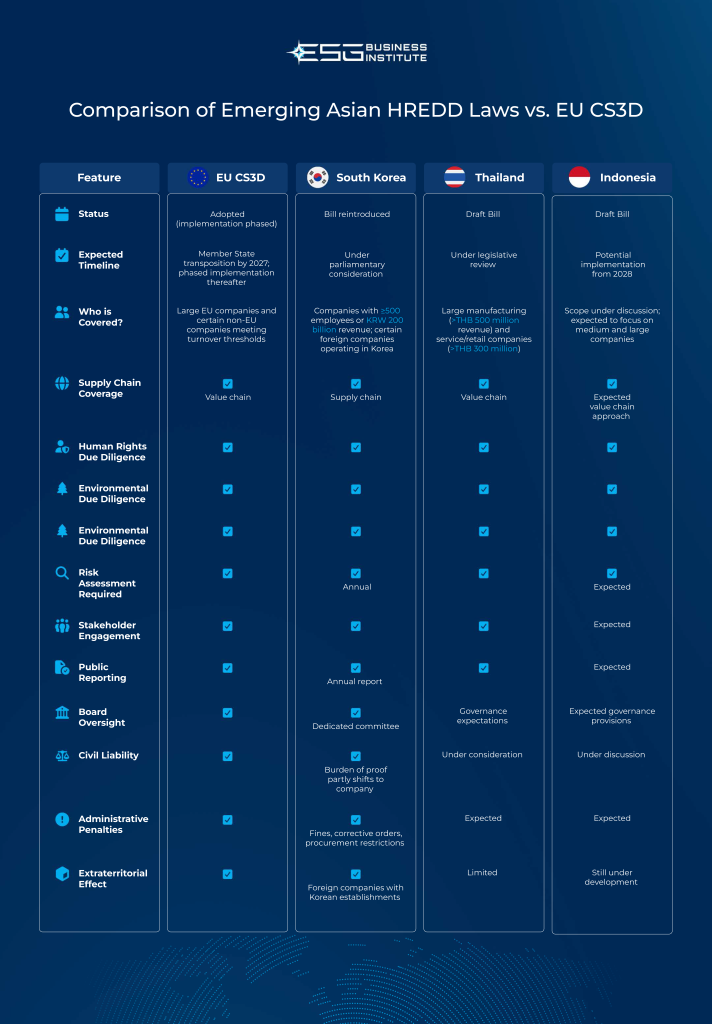
The proposed legislation would apply to companies headquartered in South Korea with at least 500 full-time employees or annual revenue exceeding KRW 200 billion (approximately USD 144 million). Foreign companies with established operations in South Korea would also fall within its scope.
The bill introduces a comprehensive set of due diligence obligations, including:
- Conduct annual human rights and environmental risk assessments across business operations and supply chains.
- Prioritizing risks based on their severity and likelihood.
- Implementing measures to prevent and mitigate identified risks.
- Publishing annual due diligence reports.
- Establishing board-level oversight through dedicated committees.
Perhaps most significantly, the proposal introduces civil liability provisions that shift the burden of proof onto companies in certain circumstances, alongside potential penalties ranging from corrective orders and fines to restrictions on public procurement opportunities.
Its extraterritorial reach means international companies with substantial operations in South Korea may also need to comply.
Thailand: Embedding Responsible Business into Corporate Governance
Thailand is following a similar trajectory through its proposed Act on the Promotion of Responsible Business Conduct, introduced in June 2025. Thailand currently has a draft bill, which is still under development, with thresholds and obligations proposed (not yet passed or a draft bill still under development, with thresholds and obligations proposed, not finalized law legalized).
Unlike South Korea’s employee-based threshold, Thailand’s proposal focuses on company size based on annual revenue. Manufacturing companies with revenue exceeding 500 million baht and service or retail businesses exceeding 300 million baht would be required to implement HREDD processes.
According to Ardea International, the proposed framework requires companies to establish:
- Human rights due diligence policies.
- Stakeholder engagement processes.
- Value chain risk assessments.
- Preventive and mitigation measures.
- Accessible grievance and remediation mechanisms.
- Public reporting on due diligence activities.
Thailand’s legislative direction aligns closely with its aspirations to join the OECD, where adherence to responsible business conduct standards forms an important part of accession discussions.
Indonesia: Accelerating Towards Mandatory Due Diligence
Indonesia is also advancing efforts toward a mandatory HREDD framework. Proposed regulatory and legislative initiatives are being developed to strengthen business and human rights due diligence requirements, reflecting the country’s increasing focus on responsible business conduct. Ropes & Gray notes that if adopted, implementation could be expected by 2028.
Indonesia occupies a particularly significant position in global supply chains. The country is a major producer of palm oil, textiles, electronics, mining products, and nickel—industries that already receive heightened scrutiny from international buyers and regulators.
Domestic factors are also contributing to the legislative momentum. Indonesia’s National Commission on Human Rights has consistently identified corporations among the leading sources of human rights complaints, reinforcing the need for stronger governance alongside growing international expectations.
Rather than simply responding to overseas regulations, Indonesia’s proposed legislation reflects an increasing recognition that responsible business conduct is becoming a national competitiveness issue.
What This Means for Regional and Global Businesses
For many companies, the emerging regulatory landscape means human rights due diligence will no longer be governed by a single jurisdiction.
Businesses sourcing from ASEAN may soon need to navigate overlapping obligations from multiple directions:
- European due diligence requirements under the CS3D.
- Mandatory HREDD laws in supplier countries across Asia.
- Existing trade enforcement measures, including the United States’ Uyghur Forced Labor Prevention Act.
- National modern slavery legislation in jurisdictions such as Australia and New Zealand.
This creates a more complex compliance environment where expectations increasingly extend beyond first-tier suppliers and into broader value chains.
As highlighted by The Diplomat, one of the greatest implementation challenges remains obtaining credible labor-related evidence across complex Asian supply chains. Documentation alone is unlikely to satisfy regulators. Effective due diligence increasingly depends on meaningful stakeholder engagement, robust grievance mechanisms, and reliable evidence that risks are actively being identified and addressed.
Meanwhile, Sustainalytics observes that investors are paying increasing attention to the evolution of mandatory HREDD frameworks across Asia, reflecting the growing importance of responsible business conduct within investment decision-making.
Looking Ahead
Asia’s emerging HREDD landscape demonstrates that responsible business regulation is no longer solely a European agenda.
As governments across the region strengthen expectations around corporate accountability, businesses that begin preparing now will be better positioned than those waiting for legislation to be finalized.
Mapping value chain risks, strengthening governance structures, engaging suppliers, and establishing effective remediation processes are becoming strategic business capabilities—not simply compliance exercises.
For organizations operating across Asia, the question is no longer whether human rights due diligence will become part of doing business, but how prepared they will be when these requirements arrive.
Figure 1. Asia-Pacific Human Rights & Environmental Due Diligence (HREDD) Legislative Landscape (2026)
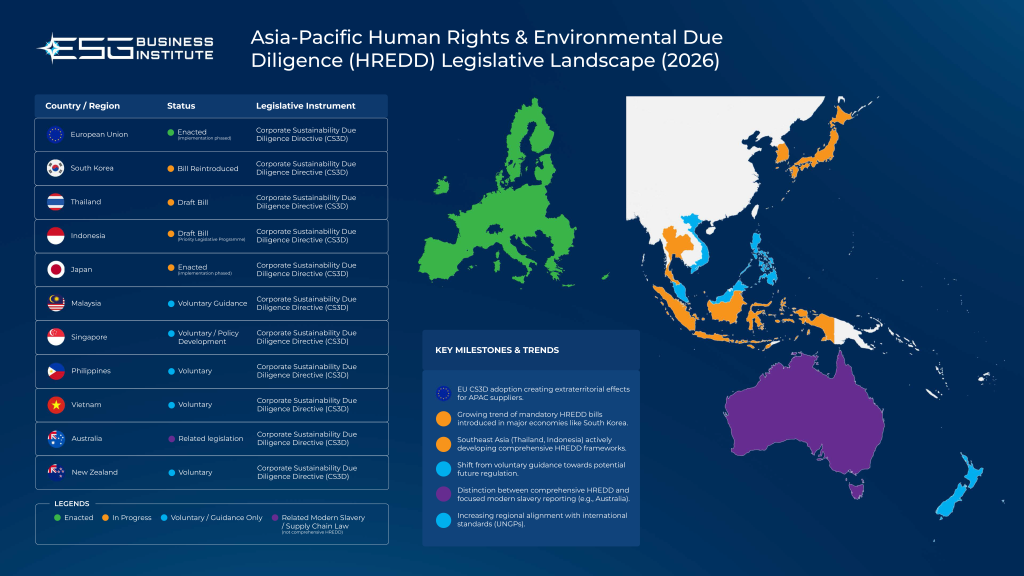
Figure 2. Comparison of Emerging Asian HREDD Laws vs. EU CS3D
ESG-BI Commentary
Asia’s emerging HREDD landscape is a signal that the region is maturing in its approach to responsible business conduct, and early movers will be better positioned than those who wait.
For companies sourcing from South Korea, Thailand, and Indonesia, beginning value chain human rights risk mapping now is a sounder strategy than waiting for final legislative text.
The most important insights are:
- Human rights due diligence is not a documentation exercise, and most definitely should not be another round of presumptuous audits.
- Where audits may not be designed to understand and address human complexity in supply chains, HRDD helps to track and understand if there is a human risk.
- It asks businesses to look beyond an audit’s assumptions and look at worker’s lived experience. It is uncomfortable.
- HRDD processes that best work …basically change the way businesses listen to workers, the associated risks, build trust and ensure a viable and credible remediation process.
What forthcoming Asian legislation—much like the EU’s CS3D—will increasingly look for is evidence of a living process: documented risk assessments, stakeholder engagement, grievance mechanisms, remediation efforts, and board-level ownership. The gap between having a policy and having a practice is where many organizations currently sit. Start where you are, be honest about what you have, and build from there with the intention to look beyond traditional audits and actually listen to workers.
Further Reading
- Ropes & Gray. An Update on Mandatory Human Rights and Environmental Due Diligence Legislation in South Korea, Thailand, and Indonesia. https://www.ropesgray.com/en/insights/viewpoints/102m2ad/an-update-on-mandatory-human-rights-and-environmental-due-diligence-legislation-i
- Latham & Watkins. South Korea Reintroduces Human Rights and Environment Due Diligence Act.https://www.lw.com/en/insights/south-korea-reintroduces-human-rights-and-due-diligence-act
- Ardea International. HRDD Legislation 2026: Key Global Changes and Business Implications.https://www.ardeainternational.com/thinking/hrdd-legislation-2026-key-global-changes-and-business-implications/
- Eyes on Asia: How the Region Is Advancing on Human Rights Due Diligence.https://www.sustainalytics.com/esg-research/resource/investors-esg-blog/eyes-on-asia–how-the-region-is-advancing-on-human-rights-due-diligence
- The Diplomat. Human Rights Due Diligence May Repeat the Limitations of CSR.https://thediplomat.com/2026/03/human-rights-due-diligence-may-repeat-the-limitations-of-csr/